In modern government, “making things simpler” is often treated as a corporate checklist—something done just to improve business rankings or fix times on a tracking dashboard. This completely misses how everyday people actually experience the state. When a government form, a scheme notification, or an eligibility rule is filled with complicated, old-fashioned, or confusing language, it does not just slow things down. It creates an information gap.
Because regular citizens cannot navigate this confusion on their own, a market pops up to fill it. Confusion is instantly turned into a business. In a growing democracy, complicated language acts as an unfair gatekeeper. Making processes and language genuinely simple is not a minor adjustment; it is a major step toward social justice that gives power back to the people and protects their dignity.
1. Turning Confusion into a “Middleman Tax”
When a public system is wrapped in confusing loops and unclear rules, it creates an unfair power balance where the state holds all the information and the individual is left guessing. To solve this confusion, a citizen has to find a translator. This structural gap creates the local intermediary—the informal middleman.
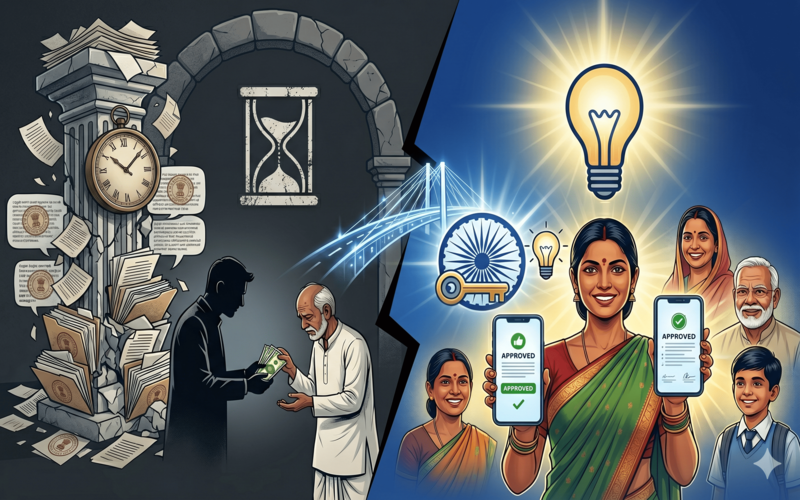
The middleman rarely charges money to break the law or cheat the system; instead, they charge a fee simply to translate the law into plain language, fill out a complicated form, or track a missing file. Consider a common everyday scene: an elderly citizen or a daily-wage laborer standing outside a district office, trying to get a pension or a land record. The form demands a specific old document format, a precise file size, or a complex statement written in legal jargon. Unable to decode the instructions, the citizen turns to a cyber-cafe operator or an agent sitting outside the building.
This friction acts as an unfair tax. Wealthy people do not read government guidelines; they have the money to hire specialists like accountants, lawyers, or consultants to buy clarity. For a daily-wage earner or a marginalized person, however, their only asset is their time. When forced to spend cash to have a public document explained, or spend days navigating an administrative maze, the system takes a literal financial and time tax from the very people it was meant to help.
2. The Feeling of Being a Beggar
Beyond the direct financial drain, there is an invisible mental cost to confusing design that hurts citizen dignity.
When people cannot understand the exact rules required to get a public service or an entitlement, their relationship with the government shifts. They no longer approach the state as an empowered stakeholder or a citizen with rights in a democracy. Instead, they approach it like a beggar hoping for a favor.
The moment a citizen has to ask an official or a middleman, “Am I eligible for this?” instead of saying, “I meet these three clear metrics, please process my application,” their democratic power is weakened. Confusion breeds a system where citizens fear arbitrary rejection because they cannot verify the rules themselves. Absolute clarity, on the other hand, transforms a vague government promise into a predictable right.
3. Fixing the Rules Before Fixing the Tech
In recent years, huge progress has been made through digital technology, yet a wide gap still remains between policy ideas and what a citizen sees on their screen. As the foundations of India’s e-Kranti (NeGP 2.0) and Digital India frameworks point out, automating a bad process is counterproductive. True reform requires Government Process Reengineering (GPR)—reshaping the workflows before they are coded into software.
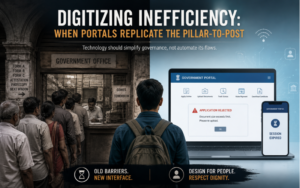
Putting a confusing, poorly drafted form onto a sleek website changes nothing; it just moves the paper maze online. For example, if a digital portal requires a citizen to upload multiple redundant documents or throws a cold “Error 500: Mandatory Field Missing” without explaining why, it replaces the physical queue with digital uncertainty. True reform means looking at the underlying rules:
- Can three mandatory document uploads be reduced to a single self-declaration?
- Can complicated eligibility loops be flattened into simple, yes-or-no checkboxes?
- Is the interface easy to use on a basic smartphone, which is the main window to the internet for the vast majority of citizens?
When processes are simplified before coding, the state removes the need for translation fees, ensuring digital tools empower people rather than leaving them out.
4. The Way Forward: Designing Readable Government
To protect citizen dignity and eliminate the hidden tax of systemic friction, public policy must use plain language as a mandatory standard. This shift can be guided by two simple design principles:
- The Primary-School Test: Public forms, notifications, and complaint guidelines should be written so they are instantly clear to someone with a basic primary education. A rule can be legally tight while remaining linguistically simple.
- One-Window Access: Departments need to stop working in isolated silos. When public services are bundled into single-window websites, the mental burden on the citizen drops drastically. A user should not need to understand the inner structure of the bureaucracy just to apply for a water connection or a basic certificate.
The True Test of Good Government: A public process is only successful when a regular citizen can access their rights independently, without relying on a middleman, and without feeling anxiety or delay.
Conclusion: The Value of Respect
Simplifying how the state talks to people is not a favor; it is an official acknowledgment of the citizen’s value. When the government removes confusion, it respects the citizen’s time, saves their hard-earned money, and treats them as an equal partner in progress. Clear governance strips away the power of arbitrary gatekeepers, turning the public square into a space of predictable, dignified, and accessible interactions for everyone.