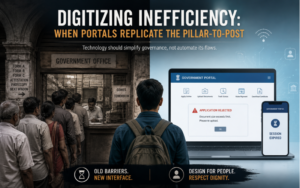
Picture long queues for utility payments, entrepreneurs running from pillar to post for approvals, and the ubiquitous presence of middlemen in government offices. Even when eligibility criteria are fulfilled, applications often remain stuck in opaque procedural loops, with a constant fear of arbitrary rejection. This is the lived reality through which citizens imagine the Indian state.
Public discourse often attributes these delays solely to corruption. However, the reality is more complex. Beyond active corruption lies a form of passive friction where no bribes are demanded and no explicit refusals are made, yet citizens face uncertainty, delay, and procedural labyrinths.
This phenomenon is not necessarily driven by corruption or a desire to exert authority. Instead, it arises from an incentive structure where wrong decisions are penalized, but delayed decisions are rarely punished. In such an environment, officials, especially at junior levels, prefer inaction over discretion. Faced with ambiguous rules, they avoid decision-making altogether. Even increasing staffing levels does not resolve this, as the core issue is not capacity but risk aversion.
The consequences are multifaceted. Economically, delays result in lost opportunities for entrepreneurs awaiting approvals and lost income for citizens navigating grievance systems. Psychologically, prolonged uncertainty fosters anxiety and helplessness.
More critically, there is a dignity cost often ignored in policy discourse. When the state disregards citizens’ time, it subtly shifts their role from stakeholders in a democracy to passive subjects. This erosion of dignity undermines the very legitimacy of governance.
Digitization alone is not a solution; it risks merely digitizing inefficiency. Without addressing underlying incentives, online systems can replicate the same delays in digital form.
The focus must shift toward designing rules that value timeliness and clarity. This includes enforceable service standards, time-bound decision frameworks, and institutional safeguards that protect officials who make good-faith decisions under uncertainty.
Bureaucratic delay functions as a hidden tax, one that disproportionately burdens the most vulnerable. While the affluent can navigate the system through intermediaries, marginalized citizens pay with their time, often their only asset.
Recognizing delay as a systemic failure, not merely an inconvenience, is the first step toward reform.