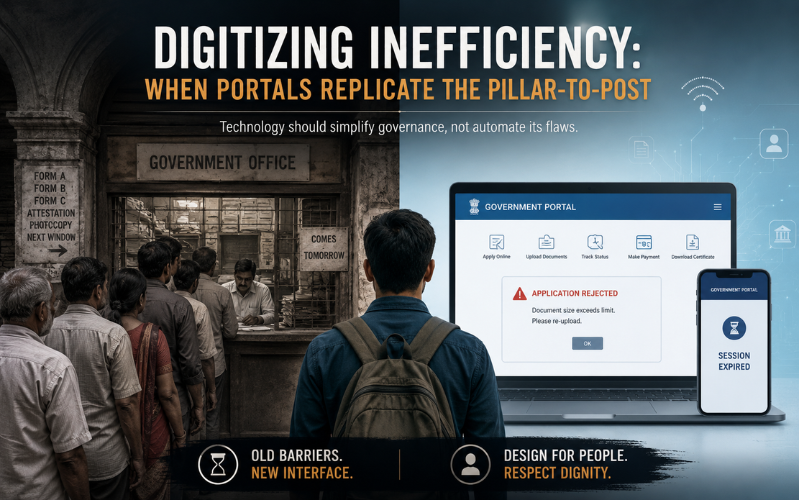
In exploring how administrative delay functions as a hidden tax, I previously argued that digital interventions risk doing little more than shifting inefficiency to the cloud. To understand why technology so frequently fails to deliver its democratic dividend, we must examine the friction that occurs when a broken analogue workflow is forced into a digital template.
Undeniably, the transition from paper to pixels holds immense transformative potential. When executed properly with intent, digitisation eliminates physical friction, slashes transaction costs, and democratizes access by removing geographical barriers. Yet, anyone navigating the contemporary interface of the Indian state encounters a stark paradox: the medium has changed, but the structural opacity remains.
The systemic flaws of our digital governance infrastructure manifest in three distinct layers:
i. The Technology Deficit: Despite a smartphone-driven expansion of internet access, many government portals continue to operate on outdated technological architectures. Frequent server downtime, poor mobile optimization, and vulnerability to even moderate traffic surges undermine their effectiveness. This is particularly problematic in a country where mobile devices constitute the primary gateway to the internet for a majority of citizens. In such circumstances, a desktop-centric portal design is not merely an inconvenience; it becomes a barrier to accessing public services. The challenge is further compounded by connectivity constraints. Although India has more than one billion mobile connections, a substantial proportion of rural users depend on low-bandwidth networks and limited data plans. Consequently, a poorly optimised portal with large page sizes and excessive data requirements imposes a tangible financial cost on users, effectively creating a digital transaction tax on those least able to bear it.
ii. Fragmented Information Architecture: There is no predictable UX (User Experience) pattern across government departments. A citizen seeking a service is forced to decode a highly fragmented web of disjointed subdomains. Instead of an intuitive public platform, the citizen navigates an administrative maze.
iii. The Tyranny of the Rigid Form: In a physical office, a frontline official possesses the operational discretion to accommodate “edge-cases” by accepting an alternative document or overlooking a minor clerical anomaly to fulfill the spirit of a policy. Digital interfaces strip away this human buffer. A rigid, unyielding form field with arbitrary file-size constraints or mandatory document uploads turns an exception into an immediate, automated rejection. The software becomes the final, unappealable arbiter.
This friction is not a failure of technology; it is a failure of design. It is precisely why the Digital India umbrella framework and the e-Kranti (NeGP 2.0) program explicitly articulated a shift toward Government Process Reengineering (GPR). The foundational doctrine of e-Kranti recognises that automation without simplification is counterproductive. It mandates that government rules, workflows, and forms must be reengineered and simplified before a single line of code is written.
Furthermore, current frameworks emphasize a “mobile first” delivery architecture and integrated, single-window service bundles to ensure citizens do not have to stitch together permissions from isolated departmental silos.
Yet, a wide chasm remains between policy design and the citizen’s screen. When a portal merely digitises an inefficient process, it doesn’t eliminate the “hidden tax”—it simply automates it. If digital governance is to truly safeguard citizen dignity, the state must stop coding for its own bureaucratic convenience and start designing for the human on the other side of the screen.